C. Richardson - Elon University
Galaxy Chemical Evolution
Current Research Interests
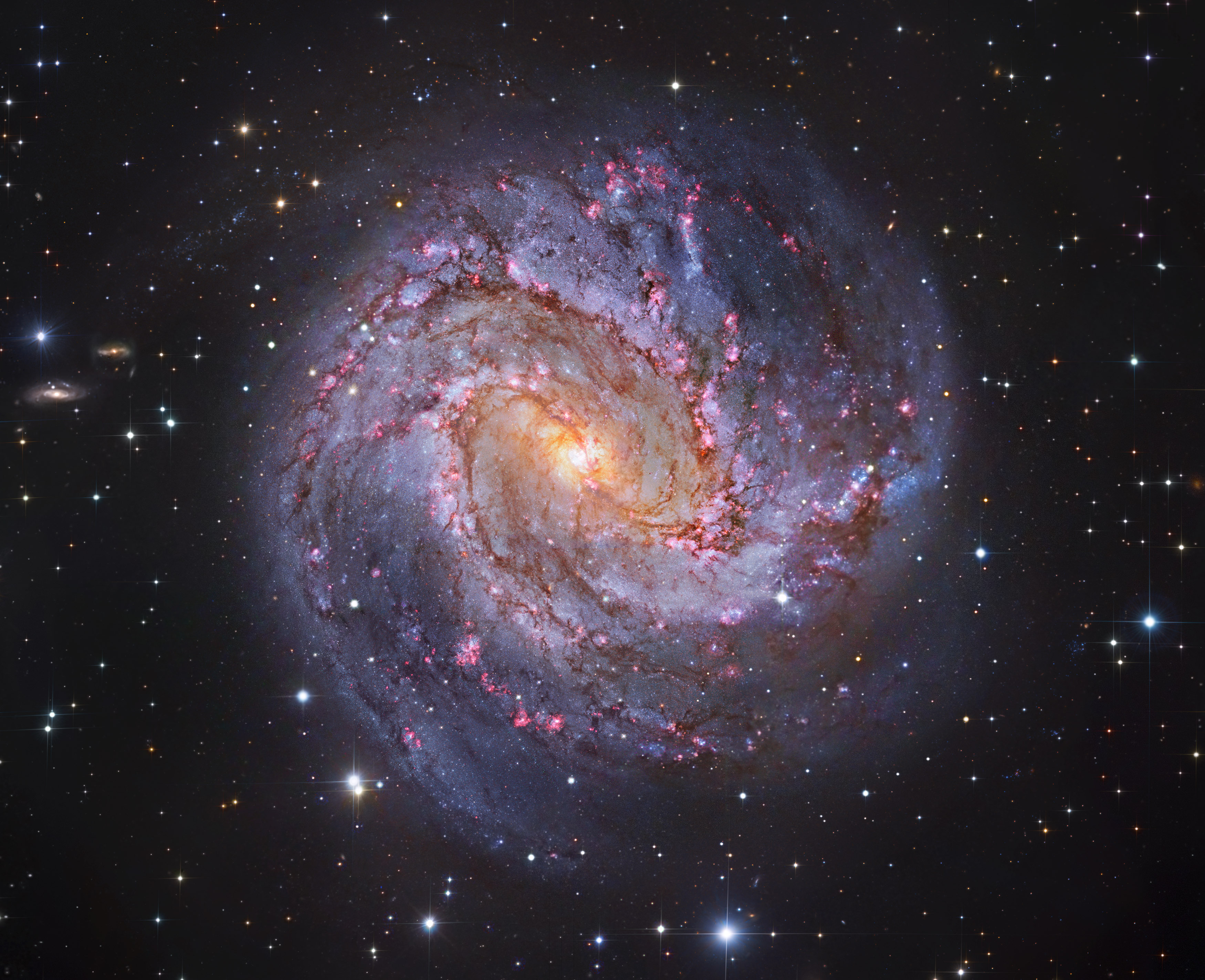 Molecular hydrogen (H2) and dust serve as building blocks for forming complex molecules that are essential for life. Unlike dust, H2 is difficult to observe at infrared wavelengths despite being the most abundant molecule in the Universe. Instead, carbon monoxide (CO), which radiates strongly at radio wavelengths is often used as a tracer for molecular gas that can fuel star formation. Those stars are visible a optical wavlengths. Exotic phenenoma emitting X-rays, like accreting black holes, can suppress star formation. Clearly, studying galaxy evolution is a multi-wavelength, multi-instrument endeavor.
I'm interested in numerical simulations to predict the formation pathways and excitation mechanisms of H2 in nearby galaxies. I want to further our understanding of the link between accreting compact objects (e.g., X-ray binaries, AGN) and star formation using multi-wavelength emission line signatures. Specifically, I'm a member of the XPHANGS branch of the Physics at High Angular resolution in Nearby GalaxieS (PHANGS) group, which seeks to map the X-ray emission of highly resolved nearby galaxies.