| Homepage | Teaching |
Research | Publications | NatureSounds |
(Email me for a pdf of any of these
papers; * = undergraduate author)
33) Gammon, D.E. and *A.M. Corsiglia. 2019. Mockingbirds imitate frogs and toads across North America. Behavioural Processes 169:103982. [abstract]
32) Gammon, D.E. 2018. Oil in the Amazon: Is Sustainable Development Possible? National Center for Case Study Teaching in Science. [abstract]
31) Gammon, D.E., and *R.P. Lyon. 2017. An acoustic comparison of mimetic and non-mimetic song in northern mockingbirds, Mimus polyglottos 105:37-42. [abstract]
30) Kershenbaum, A., T.M. Freeberg, and D.E. Gammon. 2015. Estimating vocal repertoire size is like collecting coupons: A theoretical framework with heterogeneity in signal abundance. Journal of Theoretical Biology 373:1-11 [abstract]
29) Gammon, D.E. 2014. Seasonal patterns of vocal mimicry in northern mockingbirds Mimus polyglottos. Journal of Avian Biology 45:545-550 [abstract]
28) Gammon, D.E. 2013. How is model selection determined in a vocal mimic?: tests of five hypotheses. Behaviour 150:1375-1397. [abstract]
27) Train, T.L. and D.E. Gammon. 2012. The structure and assessment of a unique and popular interdisciplinary science course for non-majors Journal of College Science Teaching 42(1):50-57. [abstract]
26) Kamela, M. and D.E. Gammon. 2012. The Mobile Science Center: Promoting Science Engagement through Service-Learning. The International Journal of Science in Society 2(4):1-12. [abstract]
25) Gammon,D.E., J.M. Platania, S. Manring, and *D. Muñoz. 2011. Economics: the overlooked discipline in Earth Stewardship. Frontiers in Ecology and the Environment 9(10):535. [abstract]
24) Kapfer, J.M, D.E. Gammon, and J.D. Groves. 2011. First detailed report of carrion-feeding by Barred Owls (Strix varia). Wilson Journal of Ornithology 123(3):646-649. [abstract]
23) Grimley, E., D. Wright, and D. Gammon. 2011. Science Without Borders. The International Journal of Science in Society 2(2):171-180. [abstract]
22) Gammon, D.E. and *C.E. Altizer. 2011. Northern mockingbirds (Mimus polyglottos) produce syntactical patterns of vocal mimicry that reflect taxonomy of imitated species. Journal of Field Ornithology 82(2):158-164. [abstract]
21) Hoeschele, M., D.E. Gammon, M.K. Moscicki and C.B. Sturdy. 2009. Note types and coding in Parid vocalizations: the chick-a-dee call of the chestnut-backed chickadee (Poecile rufescens). Journal of the Acoustical Society of America 126:2088-2099. [abstract]
20) Gammon,
D.E., *M.C. Hendrick and M.C. Baker. 2008. Vocal communication in a songbird with a novel song
repertoire. Behaviour
145:1003-1026.
19) Baker, M.C. and D.E. Gammon. 2008. Vocal memes in natural populations of chickadees: why do some memes persist and others go extinct? Animal Behaviour 75:279-289. [abstract]
18) *Wampler, E. and D.E. Gammon. 2007. Aggressive head-up displays in
great-tailed grackles (Quiscalus mexicanus).
17) Gammon, D.E. 2007. How
post-dispersal social environment may
influence acoustic variation in birdsong. In
K. Otter, ed. Ecology and Behavior of
Chickadees and Titmice: An Integrated Approach, pp. 183-197.
[Click on
image to visit website for the book 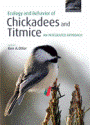 ]
]
16) Baker, M.C. and D.E. Gammon. 2007. The gargle call
of black-capped chickadees: ontogeny, acoustic
structure, population patterns, function, and processes leading to
sharing of
call characteristics. In K. Otter, ed. Ecology and Behavior of
Chickadees
and Titmice: An Integrated Approach, pp. 167-182.
15) Freeberg,
T.M., M.C. Baker, L.L. Bloomfield, I.
Charrier, D.E. Gammon, J.P. Hailman, T.T.-Y Lee, J.R. Lucas, D.J.
Mennill and
C.B. Sturdy. 2007. Synopsis
III – Complexities in vocal communication. In K.
Otter, ed. Ecology and Behavior of
Chickadees and Titmice: An Integrated Approach, pp. 235-240.
14) Auer, S.K, D.M. Logue,
R.D. Bassar and D.E. Gammon. 2007.
Nesting biology of the Black-bellied Wren (Thryothorus
fasciatoventris) in
13) Baker, M.C. and D.E. Gammon. 2006.
Persistence and change of vocal signals in natural populations
of
chickadees: annual sampling of the gargle call over eight seasons. Behaviour 143:1473-1509.
12) Gammon,
D.E.,
M.C. Baker and *J.R. Tipton. 2005. Cultural
divergence within novel song
in the Black-capped Chickadee. Auk 122:853-871.
11) Logue, D.M, D.E. Gammon and M.C. Baker. 2005.
Minidisc recorders versus audiocassette recorders: a performance
comparison. Bioacoustics. 15:15-33.
10) Gammon, D.E. 2004. Black-capped
Chickadee Dawn Chorus and Subsequent Sexual Activity. Wilson
Bulletin.
116:252-256.
9) *Johnson,
B.W., *R. Bortner, *J. Kemp, *T. Sichmiller, *
8) Gammon, D.E. and M.C. Baker. 2004. Are
conspecific vocalizations sufficient to
alter food-caching behavior in a winter-flocking bird? Bird
Behavior 16:21-26. [abstract]
7) Logue, D.M. and D.E. Gammon. 2004. Duet
song and sex roles during
territory defense in the black-bellied wren, Thryothorus
fasciatoventris. Animal Behaviour 68:721-731.
6) Gammon, D.E. and M.C. Baker. 2004. Song repertoire evolution and acoustic
divergence in a population of black-capped chickadees. Animal
Behaviour 68:903-913.
5) Baker, M.C., *M.S.A. Baker, and D.E.
Gammon. 2003. Vocal ontogeny of nestling
and fledgling black-capped chickadees (Poecile atricapilla) in
natural
populations. Bioacoustics
13:265-296.
4) Gammon, D.E., M.C. Baker and *L.
Betancourt. 2002. Juvenile
hand-raised Black-capped Chickadees
do not behave differently in response to playback of conspecific
vocalizations. Condor 104(4):854-858.
[abstract]
3) *Gammon, D.E.
and B.A. Maurer. 2002. Evidence
for non-uniform dispersal in the biological invasions of two
naturalised North American bird species. Global
Ecology and Biogeography, 11(2):155-161.
2) *Hutchinson,
A., *K.D. Hooker and D.E.
Gammon. 2001. Biotic
and abiotic factors that influence
directional nest cavity placement in Northern Flickers. Journal
of the Colorado Field
Ornithologists 35(3):112-119.
1) Maurer, B.A.,
E.T. Linder and *D. Gammon. 2001. A geographical perspective on the biotic
homogenization process:
implications from the macroecology of North American birds. In J. L.
Lockwood
and M. L. McKinney, eds. Biotic Homogenization:
The Loss of Diversity Through Invasion and Extinction, pp. 157-178.